Friday, November 11, 2011
Technology and Urban Warfare
In the article that boldly claims to answer "how technology can help us redesign our cities – and lives" the guardian recently posed the question if the devastation of the British riots last summer could have been tackled earlier or even been avoided. Space Syntax answers in the affirmative. Space Syntax believes that through their computer-aided analysis they are able to provide information for authorities to predict the location of future social disturbances. This sounds great; although it might be difficult to believe, that their advanced technology has the capacity for doing that. Space Syntax claims that the spatial layout of urban spaces and buildings excerts a powerful influence on people's behaviour: "The way that places connect is directly related to the way that people move, interact and transact". The unrefusable critique of this architectural - or spatial - determinism is that it mitigates other influences on human behaviour like social or economical imprints.Speculatively, with the technology created by Space Syntax the authorities, might become even more effective in monitoring and controling their citizens. On the one hand this might help to better tackle crime and as well informs an approach of CPTED (Crime prevention through environmental design) but on the other hand there also lies a danger of relying on new technologies as a means of fighting an urban war. In the latter, the authorities and politics lose sight of tackling the real problems and causes. As for the guardian article, I would say that the glorification of technology in the future or also current redesign of our city has to be seen much more critical. In this context there is a thin line between the use of technology as a means to improve urban living and as a means of urban warfare. Our cities will have smart buildings, smart grids, and consist of smart materials. But concepts like SmartWater that appear to be deriving right out of the last episode of CSI are reality, and I would assume these are opening the doors for further control of urban citizens.
Friday, November 4, 2011
"Bundled, Buried, and Behind Closed Doors"
mammoth recently pointed at this documentary short by Ben Mendelson and Alex Chohlas-Wood portraying the telco hotel at 60 Hudson Street in Manhattan. The former hotel is now a huge internet hub and, as the documentary speculates, may be an "outpost of a global empire". Within the physical infrastructure of the internet, 60 Hudson Street shows facinatingyly the "tendency of communications infrastructure to retrofit pre-existing networks to suit the needs of new technologies". Amongst Mendelson's and Chohlas-Wood's interviewees are Saskia Sassen as well as Stephen Graham whom we know well for his contributions on military urbanism and splintering urbanism.
Thursday, November 3, 2011
Metabolic Architecture Repairing Itself
 |
| Image source |

At the Bartlett, she is specialising in non-Darwinian techniques of evolution and the challenges of the extra-terrestrial environment. Armstrong is summarising that their research intends to generate,
"metabolic materials to counterpose Victorian technologies [to build up] architectures from a bottom-up approach. Secondly these metabolic materials have some of the properties of living systems, which means that they can perform in similar ways. They can expect to have a lot of forms and functions within the practice of architecture. And finally, an observer in the future, marvelling at a beautiful structure in the environment, may find it almost impossible to tell whether this structure has been created by a natural process or an artificial one"In her talk she suggests that it might be possible that Venice repairs itself. Let's hope that this amazing city will not sink before the protocells are ready to petrify the wooden piles it is build upon.
Tuesday, October 18, 2011
São Paulo's Highline
 |
| Picnic on Elevado Costa e Silva. Image source. |


 |
| all images by Paolo Batalha |
Nevertheless in recent years the dismantling of the expressway is demanded from various fronts, including São Paulo's Major. Also filmmaker Fernando Mereilles advocates for its destruction. The Minhocão famously featured in his film 'Blindness', since for him it 'is a perfect image to represent the madness of a city built and inhabited by the blind'. In case it is possible that the traffic can be dealt with, the destruction might be a good idea. Nevertheless, what Mereilles - who interestingly also is an architect and urban planner - and the other supportes of the highway's destruction are not thinking of is to compensate the use of the Minhocão as a public space.
 |
| Film still 'Blindness'. Image source. |
This post is part of an ongoing research on urban picnicking. More to come soon.
Thursday, October 13, 2011
Occupy Wall Street - The community and their clearing
Filmmaker Alex Mallis gives insight in the protesters' everyday life. Only in a few weeks time OWS formed a remarkable community with highly developed infrastructures at Zuccotti park. Amongst the most obvious of the emerged infrastructures are food provision, personal hygiene, and sleeping camps. Moreover the protesters also initiated a highly developed media centre at the square, with electricity from gasoline powered generators. Furtheron they have organised their own health-care with sponsored medication, and as well - since protesting and sleeping on the concrete floor has implications on the protesters' body - a massage studio. Collective cigarette rolling and musical entertainment are also amongst the activities and services the occupation of Zuccotti Park provides. Watching the short documentary very much brings into mind how informal settlements in other cities of the world work. Strinkingly, the OWS protesters generated a thriving urban space in a remarkable short period of time. What sets the OWS space apart from other informal settlements is that the mainly young protesters can tap into recources that less medialised communities are not able to access. The internet and even the installation of a shipping address (The UPS Store, Re: Occupy Wall Street, 118A Fulton St. #205, New York, NY 10038) has supported the rapid infrastructural development at Zuccotti Park.
After it was announced that the police will be clearing the privately owned public space of the protesters so that the parks owner can clean and do repairs, OWS has mounted an online effort to get the resources they need to clean up the park themselves before the police will take action on friday. The single proper reaction to this announcement. OWS is asking people to donate brooms, lots of brooms, mops, squeegees, buckets, waste bins, dust pans, trash bags, and they could use some power washers too either to bring them to the plaza or to ship them to their address (via amazon possibly).
In course of the announcement of the clearing of the plaza the letter from the park owner Brookfield Properties to NYPD leaked yesterday. Unsurprisingly they no longer tolerate the occupation. Their reasons are mainly circulating around that the 'public space' has to be clean and neat to be able to serve the local population again - which in fact are the Wall St brokers (who also were sending complaints to the owner). Hence cleanliness and locality might overcome freedom of political expression with potentially massive impact. And NYC Mayor Bloomberg approves. We are waiting with bated breath what will happen.
Finally, here is a link to the transcript of Slavoj Zizek's recent speech at Zuccotti Park.
Postscript Oct 22: The clearance of the park could have been prevented. Here is a link engaging as well with the community that evolved since the start of the occupation of Liberty Plaza: It tells us more about the barbers, cigarette rollers and other volunteer workers.
Saturday, October 8, 2011
Occupy Wall Street - Zuccotti Park
 Zuccotti park during the Occupy Wall Street protest. Image source.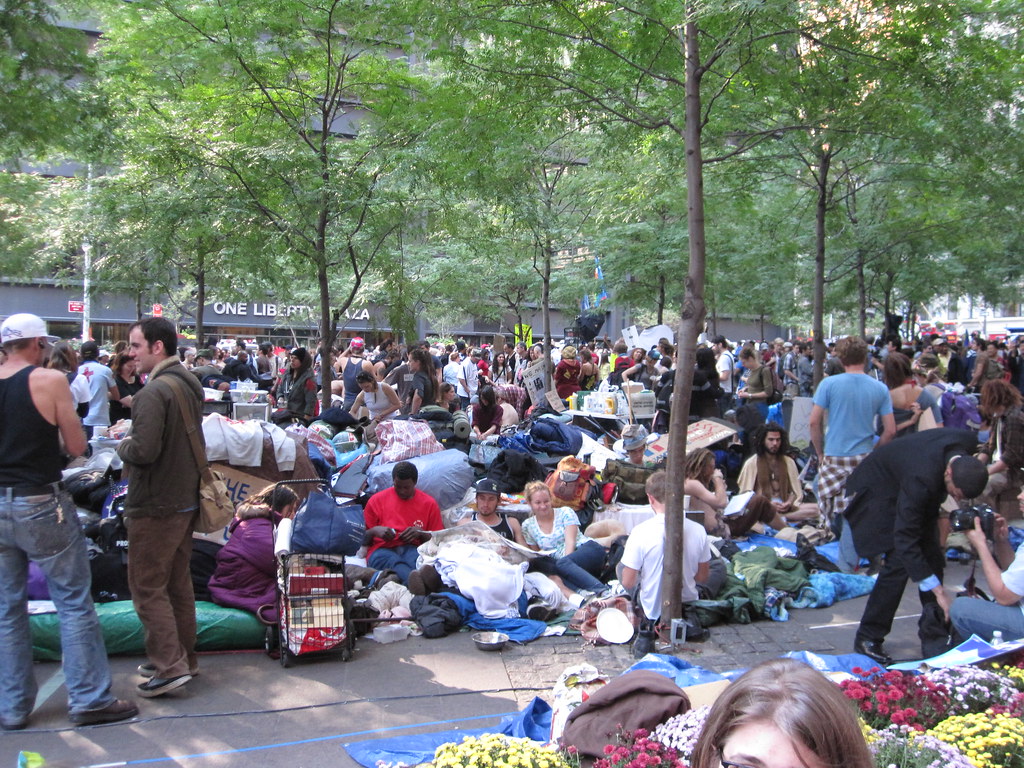
Zuccotti Park in Manhattan's financial district has become the locus for the Occupy Wall Street (OWS) protests in the last few weeks. Protesters have gathered, prostested and camped out there to make their demands visible in public. Yet, in contrast to other recent social movements the site of protest is not a public space in its common sense. Zuccotti Park is privately owned, named after a real estate development lawyer who has been active both in governmental affairs and in private development. The park, which is actually a paved plaza, is owned by Brookfield Properties, in conjunction with its ownership of One Liberty Plaza, the adjacent high-rise commercial tower. Arguably the park is a privately owned public space, a quasi public space that is so common in city centres of the great capitalist cities. Nevertheless, and interestingly, the space is still a site to enact democratic action.
OWS's spatial setting is different than those of other urban movements like the arab spring which is closely connected to Tahrir Square for example. OWS' site was chosen deliberately due to its symbolic character, as being right in the middle of New Yorks financial district. The occupation of Zuccotti park IS already the occupation of a piece of Wall Street.
Besides, the park has quickly become a tourist attraction.
Also Peter Marcuse has written a worth reading comment on the protest.
 Zuccotti park after the post 9/11 refurbishment. Image source.

Friday, March 4, 2011
Tower of David
Squatters on the Skyline (via NYT):
Facing a mounting housing shortage, squatters have transformed an abandoned skyscraper in downtown Caracas into a makeshift home for more than 2,500 people.
Subscribe to:
Posts (Atom)