Pages

Showing posts with label public space. Show all posts

Friday, February 17, 2012

This Ain’t California – Skateboarding and the City in the GDR

Skateboarding at Alexanderplatz. Film still ‘This Ain’t California’
Public space in the GDR was - as in manyother autocratic societies - understood as a means of political representationof the regime. The occupation of East Berlin by the USSR and the foundation ofthe GDR also entailed a radical change in the configuration and understandingof urban public spaces. One of the foundational principles of the GDR wasovercoming of previous epochs, which also influenced urban planning and thebuilt environment. As a first measure, the demolition of buildings that had beenclosely associated with Prussia should make space for the new regime. Therefore buildings like the Berlinpalace (Stadtschloss) and Schinkel’s Bauakademie needed to give way forpublic spaces as sites of organised mass events. East Berlin got rebuild as the’centre of a representative publics’, a space of self-staging. Moreover thebuilt environment should represent the collective thinking of the socialiststate through grand gestures of buildings beyond human scale provokinghumbleness in its citizens. The individual was subordinate and rendered smallunder the overwhelming influence of the state. With grand axes and vast openspaces, East Berlin’s new city centre should appear as one continuous space. Alexanderplatz, the space around the impressivenew TV Tower was designed as one continuous concrete surface that should laterbecome a heaven for skateboarders.


The German documentary ‘This Ain’t California’ by MartenPersiel, which premiered a few days ago at the BerlinaleFilm Festival is an impressive document of skateboard culture in the GDR andalso got me thinking about public space in GDR Berlin. The director brought togethera former GDR 1980s skateboard gang, whose members vividly reminisce about howthey built their first Rollbrett andlater smuggled skateboards from the West to the East and how the skateboardingscene grew in the GDR. The terrific film sets the subculture of skateboardingin the context of the political landscape of that time.  At a time when the Eastern bloc alreadystarted to crumble, a vivid skater culture, partly autonomous partly withWestern influence developed. The concrete desert of East Berlin’sAlexanderplatz was on the one hand the most obvious stage for the skaters onthe other hand also a site of subverting the authoritative socialiststate.  The public space no longerwas a means of representation or intimidation, through skateboarding it got aplace for self expression and if not intentionally also for resistance. 


Skateboarding at Alexanderplatz. Film stills ‘This Ain’t California’

In the GDR, sport was highly reputable andpromoted. Especially top-athletes, and the GDR had many of them, were highlyrespected as representatives of their state. But skateboarding was not such asport, since it was seen as a pop-cultural capitalist threat invading from theWest. Therefore, as the documentary depicts, the skateboarders where surveyedby the Stasi as potential dissident citizens. Simultaneously authorities triedto control the teenagers through the installation of institutionalisedfacilities to train and coach this new sport to make the GDR also competitivein international skateboarding events. Obviously these institutions were neverreally successful amongst the skateboarders, as also in the GDR the sport wasmore understood as a way of life rather than a sporting discipline.
Arguably, the act of skateboardingquestioned the state of public spaces of the socialist regime. Skateboarding,or in GDR terminology Rollbrettfahren,was a form of embodied resistance and rendered the space as a representationalspace. As the documentary clearly elucidates, not only in the West but also inthe East skateboarding was built on an anarchist tradition of hacking the urbanlandscape.  Iain Borden (authorof  Skatebordingspace and the city: architecture and the body) argues in a Lefebvrian sensethat ‘skateboarders see the city as a place to assert use values over exchangevalues, pleasure over toil, active bodies over passive behaviours’. In otherwords, skateboarders communicate a Marxist approach that public space is foruses rather than exchange. In this sense, in a way, skateboarding would havebeen a spatial practice that was in conformity with socialist ideologies. Butin former Eastern Germany there was no such thing as a capitalist abstractspace the skateboarders could challenge with their activity, as public spacewas never a space of consumption. Nevertheless skateboarding as depicted in‘This Ain’t California’ was an implicit critique of what public space shouldbe, a critique that was true for both the East and the West. 
Skateboarding in East Berlin, Thrasher Magazine, December 1988


Skateboarding at Alexanderplatz. Film stills ‘This Ain’t California’
 Apart from raising questions about publicspace the documentary is a highly recommendable and entertaining film thatcomments on GDR politics, youth culture and everyday life through an impressiveamount of original footage. Of course, the film also resonates with a certainnostalgia for old school skateboarding and in general for GDR aesthetics,  so called Ostalgie.

Friday, December 16, 2011

International Public Space Library


Image source
IPSL book (source)
The International Public Space Library’s (IPSL) ambition is to offerbooks for free in public spaces all around the world. Soft-launched inSeptember 2010, under the light of the recent occupy movement the experimenthas gained new topicality.  Unlikea traditional library, the IPSL has no physical building or location. Each oneof the books, anonymously donated, contains an IPAL label and are left inpublic spaces, free to pick up. Readers are encouraged to return the book afterreading to the library by placing it at another space.
Anyone can donate a book to the IPSLcollection. Just download a PDF copy of the IPSL ex libris here or download the imagebelow, print and affix it inside the front cover of the books you want to shareand spread them (but make sure they don’t get wet). With more publicity this project potentially is able to build up the greatest library of the planet and fromulates a challenging growing spatial configuration of a library consisting of connections and movements of books. "Libraries are not made; theygrow." (Augustine Birrell(1850-1933), Chief Secretary of Ireland)


During the just started 7-day growingexhibition on Strategiesfor Public Occupation by the Storefrontfor Art and Architecture, the IPSL will launch a temporary ‘pop-up’ branch.This temporary library will offer a selection of books to help stimulate theongoing public discussion of economics, politics, society and culture that maybe reflective of the Occupy Wall Street movement and other social movementsthat have been or are currently powered by the free exchange of ideas,particularly through the sharing of books. At Liberty Plaza (Zuccotti Park) theoccupiers established The People’s Librarywith a collection of more thatn 5500 books, unfortunately most of them got missingafter the police raid to clear the park in November.

Tuesday, October 18, 2011

São Paulo's Highline

Picnic on Elevado Costa e Silva. Image source.
The city of São Paulo is famously known for its congested streets and highways and as well its tremendous lack of public space. In the 1970s the Elevado Costa e Silva (also known as the Minhocão - the 'big worm') was built to relieve the load of the traffic in the city centre. Right from the beginning the infrastructural project has been very contested, since the elevated highway was boldly erected in the inner cities street canyons leading the traffic only few meters away of the windows of the neighbouring buildings. This fact has rendered an ongoing discussion to destruct the highway ever since it has been built. In order to compensate the infrastructural misplanning the city government has decided to close the route from Monday to Saturday during nighttimes and also during daytimes on Sundays only a few years ago. Hence the 2.2 miles long Minhocão has become a space for leisure in the city where public space is scarce. For many residents the highway, paradoxically, has become a retreat from the chaos of the congested city to enjoy a minimum of leisure time. Hence especially on Sundays the park is packed with runners, dog walkers and even picnickers. Therfore each week a linear park evolves comparable to New York City's Highline - both are successfull, but the Minhocão doesn't need an awarded design firm for its public activation.


all images by Paolo Batalha

Nevertheless in recent years the dismantling of the expressway is demanded from various fronts, including São Paulo's Major. Also filmmaker Fernando Mereilles advocates for its destruction. The Minhocão famously featured in his film 'Blindness',  since for him it 'is a perfect image to represent the madness of a city built and inhabited by the blind'. In case it is possible that the traffic can be dealt with, the destruction might be a good idea. Nevertheless, what Mereilles - who interestingly also is an architect and urban planner - and the other supportes of the highway's destruction are not thinking of is to compensate the use of the Minhocão as a public space. 

Film still 'Blindness'. Image source.


This post is part of an ongoing research on urban picnicking. More to come soon.

Thursday, October 13, 2011

Occupy Wall Street - The community and their clearing


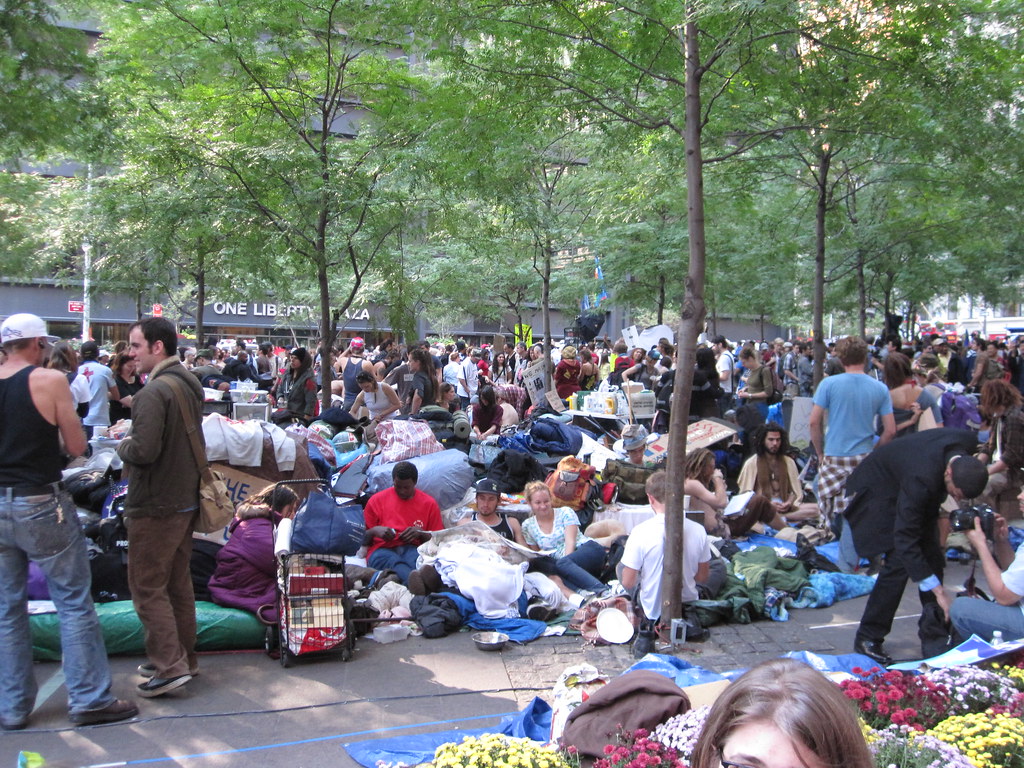
Filmmaker Alex Mallis gives insight in the protesters' everyday life. Only in a few weeks time OWS formed a remarkable community with highly developed infrastructures at Zuccotti park. Amongst the most obvious of the emerged infrastructures are food provision, personal hygiene, and sleeping camps. Moreover the protesters also initiated a highly developed media centre at the square, with electricity from gasoline powered generators. Furtheron they have organised their own health-care with sponsored medication, and as well - since protesting and sleeping on the concrete floor has implications on the protesters' body - a massage studio. Collective cigarette rolling and musical entertainment are also amongst the activities and services the occupation of Zuccotti Park provides. Watching the short documentary very much brings into mind how informal settlements in other cities of the world work. Strinkingly, the OWS protesters generated a thriving urban space in a remarkable short period of time. What sets the OWS space apart from other informal settlements is that the mainly young protesters can tap into recources that less medialised communities are not able to access. The internet and even the installation of a shipping address (The UPS Store, Re: Occupy Wall Street, 118A Fulton St. #205, New York, NY 10038) has supported the rapid infrastructural development at Zuccotti Park.

After it was announced that the police will be clearing the privately owned public space of the protesters so that the parks owner can clean and do repairs, OWS has mounted an online effort to get the resources they need to clean up the park themselves before the police will take action on friday. The single proper reaction to this announcement. OWS is asking people to donate brooms, lots of brooms, mops, squeegees, buckets, waste bins, dust pans, trash bags, and they could use some power washers too either to bring them to the plaza or to ship them to their address (via amazon possibly).
In course of the announcement of the clearing of the plaza the letter from the park owner Brookfield Properties to NYPD leaked yesterday. Unsurprisingly they no longer tolerate the occupation. Their reasons are mainly circulating around that the 'public space' has to be clean and neat to be able to serve the local population again - which in fact are the Wall St brokers (who also were sending complaints to the owner). Hence cleanliness and locality might overcome freedom of political expression with potentially massive impact. And NYC Mayor Bloomberg approves. We are waiting with bated breath what will happen.

Finally, here is a link to the transcript of Slavoj Zizek's recent speech at Zuccotti Park.


Postscript Oct 22: The clearance of the park could have been prevented. Here is a link engaging as well with the community that evolved since the start of the occupation of Liberty Plaza: It tells us more about the barbers, cigarette rollers and other volunteer workers.

Saturday, October 8, 2011

Occupy Wall Street - Zuccotti Park

Zuccotti park during the Occupy Wall Street protest. Image source.

Zuccotti Park in Manhattan's financial district has become the locus for the Occupy Wall Street (OWS) protests in the last few weeks. Protesters have gathered, prostested and camped out there to make their demands visible in public. Yet, in contrast to other recent social movements the site of protest is not a public space in its common sense. Zuccotti Park is privately owned, named after a real estate development lawyer who has been active both in governmental affairs and in private development. The park, which is actually a paved plaza, is owned by Brookfield Properties, in conjunction with its ownership of One Liberty Plaza, the adjacent high-rise commercial tower. Arguably the park is a privately owned public space, a quasi public space that is so common in city centres of the great capitalist cities. Nevertheless, and interestingly, the space is still a site to enact democratic action.
OWS's spatial setting is different than those of other urban movements like the arab spring which is closely connected to Tahrir Square for example. OWS' site was chosen deliberately due to its symbolic character, as being right in the middle of New Yorks financial district. The occupation of Zuccotti park IS already the occupation of a piece of Wall Street.
Besides, the park has quickly become a tourist attraction.
Also Peter Marcuse has written a worth reading comment on the protest.
Zuccotti park after the post 9/11 refurbishment. Image source.