Pages

Wednesday, February 16, 2011

Mapping The Crime


Last week police.uk launched a map of every single crime recorded in December last year in England and Wales. The phenomenal reaction to the launch caused the crashing of the website. With a resolution down to the street level everyone is now able to track the safety of their neighbourhood. Updated monthly the maps can be filtered according to different sorts of crimes and even Anti-social behaviour incidents are mapped. I wonder what impact this has on for example real estate prices or neighbourhood watching. If you're looking for a flat wouldn't you check the crime map before? Policing Minister Nick Herbert said the Government was determined to provide as much detailed information as possible. "We can't sweep crime under the carpet," he said. "We have to tell the truth about crime and where it is happening and give the information and the power to the public." Apart from informing the public, access to this data might also fuel fear and the suspicion and mistrust to your neighbours. It even might be possible to identify crime victims due to it's accuracy.
In response to the crash of the website the guardian launched their own map with the feature of comparing different areas and crimes .

Thursday, January 27, 2011

Militant Modernism

Berlin Hansaviertel

During a recent research I came across to an incredible collection of vintage postcards depicting mostly modernist buildings in Germany, France and the Netherlands. The postcards mainly dated from the 50s, 60s and 70s show less known modernist structures in a sometimes almost romantisising manner. Advertising the new way of living, nowadays the depictions appear less unattractive for a general viewer. Taufkirchen close to Munich

Lelystad Kantoorgebouwen

The failure of many modernist housing induced a trend towards building of diseneyfied pre-industrial public housing. This trend is especially apparent in Great Britain. In Prince Charles' experimental town Poundbury designed by Leon Krier and built in the 1990s the houses follow a pastiche of various traditional anti-modernist styles. In strong opposition to these developments is Owen Hatherley's book Militant Modernism, a manifesto for a rebirth of socialist modernism. As the Guardian reviews: 'Hatherley's book is an intelligent and passionately argued attempt to "excavate utopia" from the ruins of modernism'. The book refers to built and un-built examples of the Smithons, the Park Hill estate in Sheffield, Heygate in London or the Bevin Court designed by Tecton. Apart from the the chapter of the industrial and brutalist aesthetics in Britain, Hatherley references Russian Constructivism in architecture, the Sexpol of Wilhelm reich in film and design and the alienation effects of Brecht and Hanns Eisler on record and on screen - all aruing for a Modernism of everyday life. As written on the book cover: 'This book is a defence of Modernism against its defenders (...) it attempts to reclaim a revolutionary modernism against its absorption into the heritage industry and the aesthetic of the luxury flat.'

Royen

Royen

Royen

Royen

Pratteln

Montelimar

Ludwigshafen

Berlin

Montepulciano


All Images by Hansaviertel

Friday, October 22, 2010

David Harvey: Crises of Capitalism

In this animation human geographer and social theorist David Harvey asks to look beyond capitalism and aim for a new social order that would allow us to live within a system that really could be responsible, just, and humane. Amazingly drawn!

Tuesday, September 7, 2010

Biennale Review

'The first decade of the 21st century is ending in a succession of radical changes. In this context of rapid evolution, can architecture be the mouthpiece for new values and modern lifestyles? The 2010 Biennale is the opportunity to test architecture's numerous possibilities and to account for its plurality of approaches. Every one of its orientations relates to a different way of living.'

Director Kazuyo Sejima's statement - by the way the first woman to direct the Architecture Biennale - resulted in the less pretentious 12th International Architecture Exhibition in the absence of 'Lynnadids'.
In the previous editions of the exhibition the vast and beautiful spaces of the Corderie dell'Arsenale used to act as a mere background for sculptures of 'Star-Architects'. This year the installations refer directly to their sourrounding and create a series of diverse and interesting spaces. Probably the most beautiful and definitely the most poetic of these spaces is Matthias Schuler's (Transsolar) and Tetsuo Kundo's Cloudscape.
An artificial cloud hanging between the columns which could be gradually experienced through a lightweight spiral ramp. You enter the cloud from cool and dry climate underneath until the cloud fully embraces you. When reaching the top the climate gets warm and dry and sight becomes clear. The cloud is generated through different pressures of air.::image source

Canadian artist Janet Cardiff's sound installation 'The Forty Part Motet' is intangible. In the early modern hall under the wooden pitched-roof a choral of Thomas Tallis (1514-1585) hangs in the air. 8 x 5 speakers - arranged in an ellipse - distribute Tallis' 'Spem in alium'. Forty vocal scores expand the space and create a touching experience of the space.
Both installations deal strongly with the experience of space and its physiological and psychological impact on the human body.

The second main exhibition at the Palazzo del Esposizioni as well showed a heterogeneous overview of contemporary architecture production. Next to known offices from Japan like Atelier Bow Wow, Sejima's SANAA and Toyo Ito Biennale proved Aranda/Lasch as well as many young practices showed their conceptual approaches - few of them really outstanding but as a whole a highly informative cross-section.
Most intriguing was OMA's mini exhibition on Preservation. With the theme of CRONOCAOS, ::OMA/AMO, 'Preservation', exhibition view

OMA explores the wrenching simultaneity of preservation and destruction, which is destroying any sense of a linear evolution of time - an intelligent and critical debate on preservation. Additionally their new project for Venice's Palazzo Tedeschi which is to be converted to a shopping mall/cultural center was shown to the public for the first time.

Many of the pavillons of the participating nations were dealing with the theme 'People meet in Architecture'. Outstanding: the Netherlands, the winner of the Golden Lion Bahrain, Japan on the 50th anniversary of Metabolism, Canada, Croatia with their floating Pavillon.

:: The Netherlands on vacant spaces


:: Canadian Architect philip beesley's installation 'hylozoic ground'


:: Croatian floating pavillon, source

In summary it can be said that it is one of the most interesting yet heterogeneous architecture Biennales. An overview of alternative contemporary architecture without laying claim to completeness.

::all images by synchronictiy unless otherwise indicated

Wednesday, August 25, 2010

Off For Biennale di Venezia

::'balancing act' by ensamble studio at the arsenal building in venice, italy
image courtesy of ensamble studio


Synchronicity is heading towards Venice for the opening of the 12th International Architecture Exhibition Biennale di Venezia. I am very curious about what director Kazuyo Sejima will come up with. People meet in architecture is this year's theme and my guess is that the exhibitions will be quite different from the last architecture Biennale curated by Aaron Betsky which was somewhat dissapointing.
The Golden Lion for Lifetime Achievement has been awarded to the Dutch architect Rem Koolhaas/ OMA. OMA will also be presenting an exhibition entitled 'preservation', which looks at our sense of duty towards history and aims to redefine the under-explored theme beyond architecture's disciplinary boundaries. Synchronicity will report soon about the exhibitions via comments and images. Stay tuned.

The new header image is a picture of South African artist Moshekwa Langa's installation Temporal Distance (With Criminal Intent). You Will Find Us in the Best Places. A city made of twines and bottles. The picture was taken at the 2009 International Art Exhibition Biennale di Venezia (image by synchronicity).

In the archives:

BIENNALE DI VENEZIA - ARSENALE

Tuesday, August 17, 2010

Weather = Energy

In the amazingly beautiful competition entry for the Land Art Generator Initiative by Paisajes Emergentes and Lateral Office weather is used to create energy. Read an extract of the team's project statement:

WeatherField is a shape-shifting energy generation park along a strip of sandy beach in Abu Dhabi between Yas and Saadiyat Islands. The park is an open public space and is capable of harvesting the abundant renewable energy resource of wind within the Middle East context. The public park offers a variety of ways to engage with climate and renewable energy, as an economic sponsor, as a visual or physical experience, and as information.

Unlike current renewable energy fields where technologies are publicly inaccessible, static, and always on, WeatherField offers a range of public engagement dependent upon wind, sun, and moisture. Energy generation becomes a public performance, dynamic, reactive, and interactive. The park is active when weather events are active, and calm when weather is calm, in each instance offering the public a compatible experiences.
Paisajes Emergentes: Luis Callejas, Sebastián Mejia, Edgar mazo, Alexander Laing
Lateral Office: Mason White, Lola Sheppard, Matthew Spremulli, and Fei-Ling Tseng.

The rest of the statement can be found on their flickr page.
Of course, a high efficiency of the proposal is questionable. But in my opinion the real quality lies in the aesthetic statement of the land art project and, as well, that the ground and aquatic ecology is almost undisturbed.

:: source of all images

In the archives:
Wind Energy Replaces Oil From The Gulf
Wind Of Change
Hydro Visions

Monday, August 16, 2010

Pneumatique


:: Paris, image source
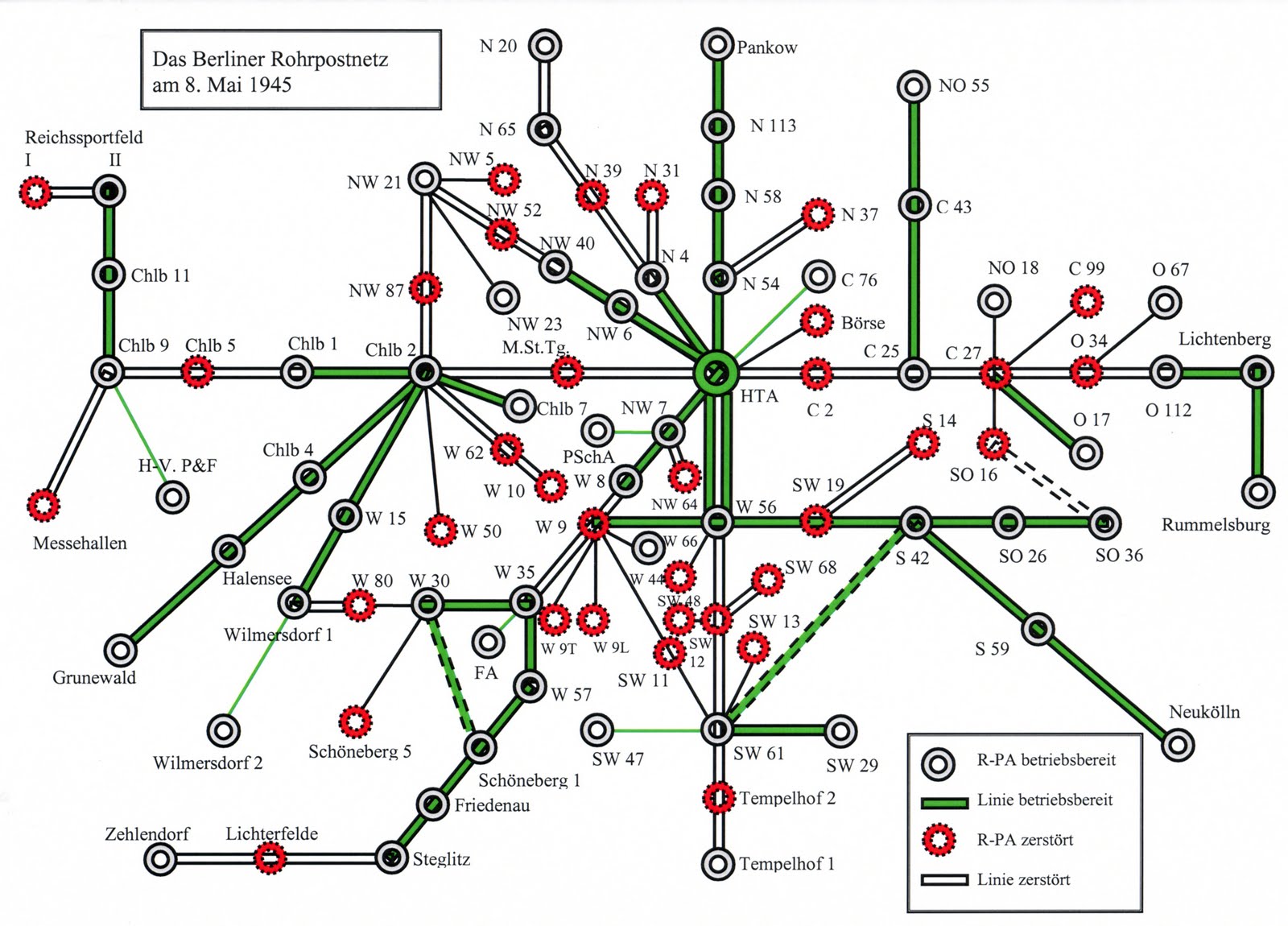
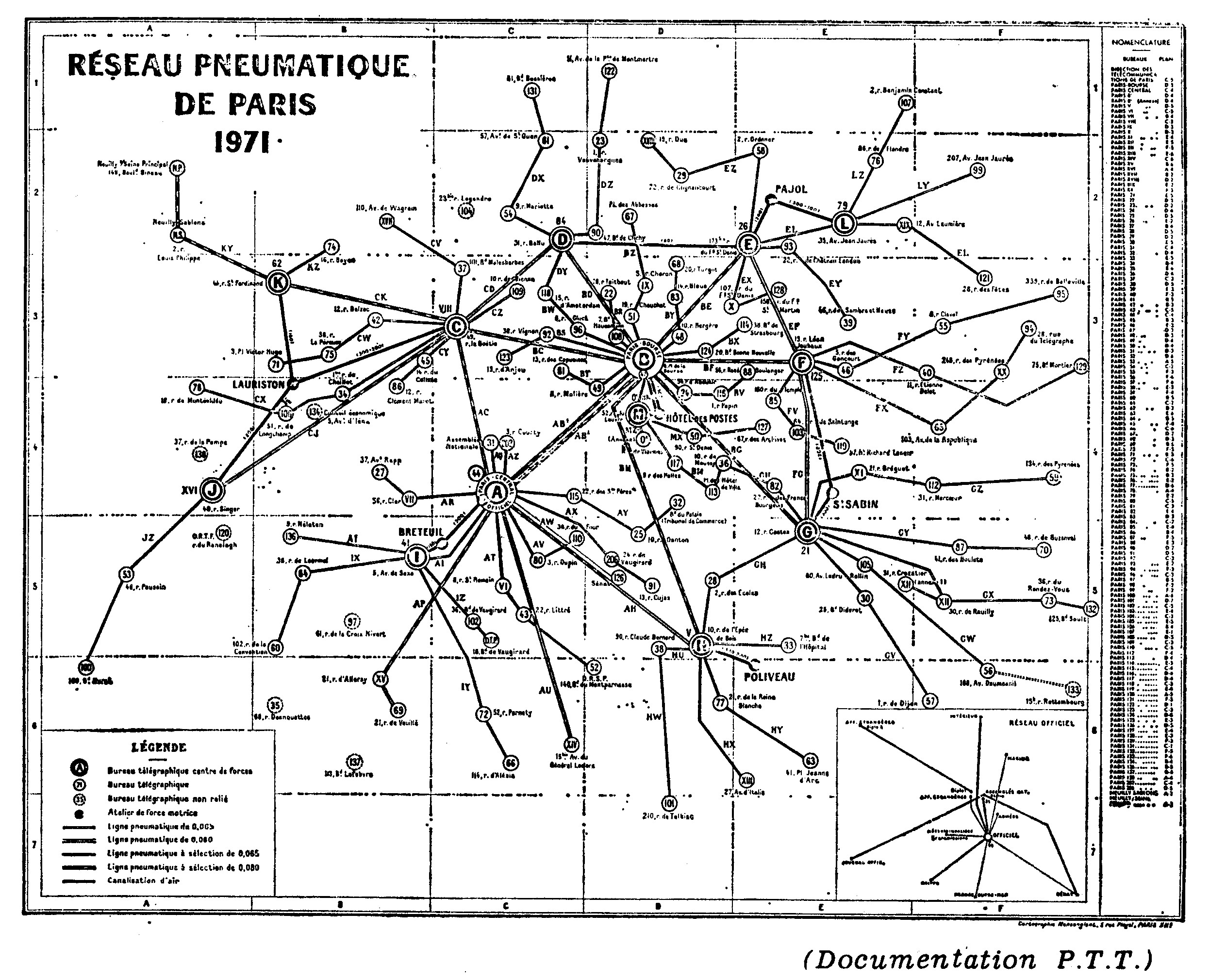
Pneumatic post or pneumatic mail is a system to deliver letters through pressurized air tubes. It was invented by the Scottish engineer William Murdoch in the 1800s and was later developed by the London Pneumatic Dispatch Company. Pneumatic post systems were used in several large cities starting in the second half of the 19th century (including an 1866 London system powerful and large enough to transport humans during trial runs - though not intended for the purpose), but were largely abandoned during the 20th century.Recently I came across this interesting text on the pneumatic post in Paris. A major network of tubes was in use until 1984, when it was finally abandoned in favor of computers and fax machines. This invisible network under the city is highly fascinating in terms of its size and capacity. For example in Paris the peak was in 1945 where 11.271.228 deliveries were sent through the 467 km long tube system. :: Rohpost Berlin 1885, image source
:: Damages on Berlin's pneumatic post after WW II, image source
Also Berlin sustained a pneumatic system called 'Rohrpost' of 400 km until the years 1963 (West) and 1976(East).Link:: Prague, image source
In Prague, in the Czech Republic, a network of tubes extending approximately 60 kilometres in length still exists for delivering mail and parcels. Following the 2002 European floods, the Prague system sustained damage, and operation was mothballed indefinitely.:: New York City's pneumatic subway in 1870, image source
New York City even had a pneumatic subway in the 1870s. Over 400,000 New Yorkers took a joy ride underground during the three years the pneumatic subway was open for demonstration. In 1873 , a stock market crashed killed financial support and thus the extension of the pneumatic subway.